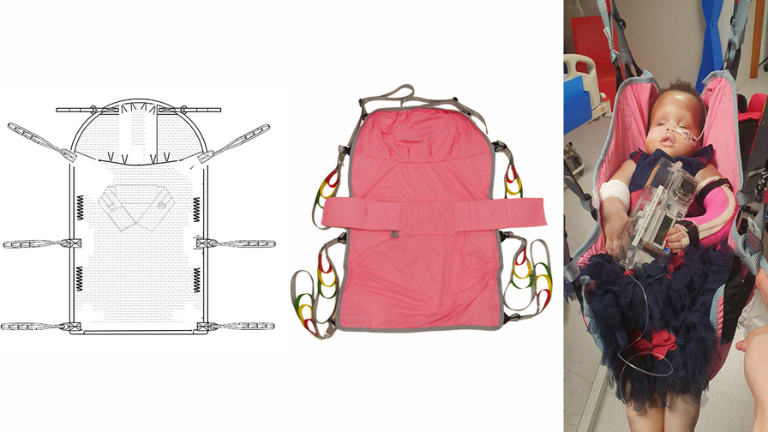
Scenario
Silvalea received a Tailor-Made Sling request from Margaret Smith of M.A. Smith Associates to create a sling for safely transferring a young child with Osteogenesis Imperfecta (OI). Given the complex needs outlined, the request was escalated to Silvalea’s Research and Development Team, which comprises three experts with over 60 years of combined experience.
Background information on the child:
- Gender: Female
- Age: 1 year 11 months
- Weight: 14.5 kg
- Condition: Osteogenesis Imperfecta (OI), a genetic disorder causing fragile bones.
- History: The child, nearly 2 years old, experiences frequent fractures and has an enlarged head, breathing difficulties, and limited spine flexibility. Previous slings caused her head to push forward, leading to panic and further risks, including overheating. Currently, she is on bed rest with fewer fractures due to side nursing and removable plaster casts.
Purpose of the sling:
- To enable minimal transfers between bed, wheelchair, or shower bed while keeping her on her side most of the time.
Challenges:
- Minimise localised pressure and reduce fracture risk.
- Maintain a maximum 30-degree reclined position.
- Ensure the sling fits exact dimensions and provides head support.
- Control overheating and identify a compatible hoist spreader bar.


Development
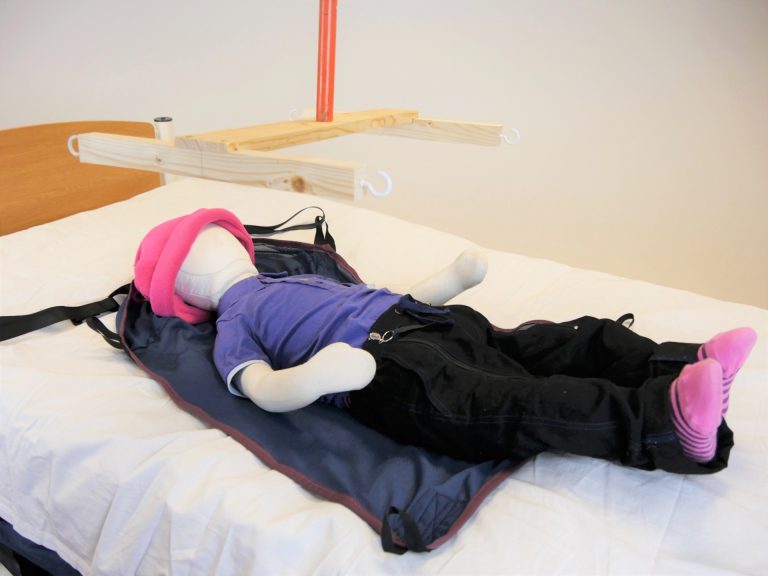
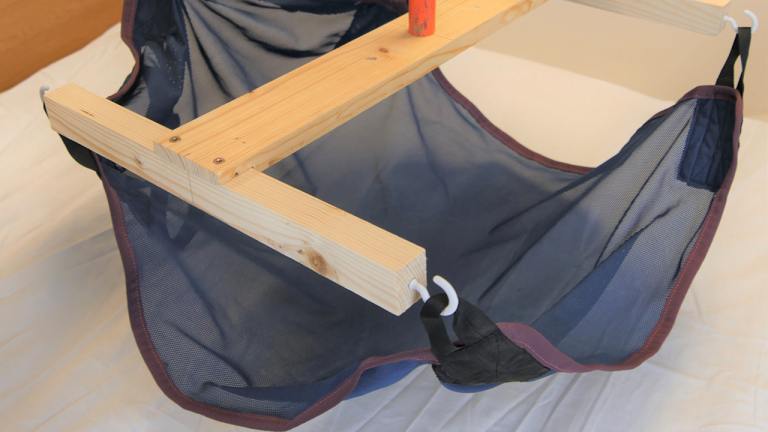
A specification was drawn up, necessitating a prototype sling to recreate the scenario due to its complexity. Silvalea’s Maintenance Manager, Terry King, crafted a model hoist matching the recommended dimensions.
After manufacturing the prototype sling and model hoist, a suitably sized doll was used for practical testing. Results and images were sent to Margaret for review by the multidisciplinary medical team.
A tailor-made in-situ sling was deemed most appropriate, as it could be customised to exact measurements, reducing seams and facilitating easier application and removal. A stretcher-style sling was selected to provide multiple pick-up points and minimise localised pressure. Initial suggestions for standard boarding within the sling were discarded due to difficulties removing the boards post-transfer, which could risk further fractures.
The Silvalea team considered using Superfine Plus or Silva-Superfine with COOLMAX® fabric. The double-layered Silva-Superfine with COOLMAX® was preferred for its firmness and heat-reducing properties. A concave shape in the headrest was incorporated to support the child’s head and alleviate distress. Measurements were finalised to ensure proper fit and support.
Success
The completed sling was trialed in the hospital with the child’s family and monitored by the Multidisciplinary Medical Team, who assessed the child’s medical and care needs. Etac UK supported this process with a Molift 180 mobile hoist fitted with a large 4-point spreader bar.
Each move was planned to minimise risk. The child was rolled side to side as the sling was aligned and fitted. Correct loop attachments and lengths were adjusted to ensure an even lift, with the child positioned semi-reclined (30 degrees). Head tapes were fine-tuned to support her head’s weight and breathing.
Despite high anticipation and anxiety, the child was successfully hoisted from bed to her specialist chair without issues. She was later returned to bed, to the relief and joy of her mother and the medical team.
The Occupational Therapist noted, “Margaret’s expertise was crucial for this complex case. Mainstream equipment was unsuitable, so a bespoke assessment was required. The sling was successful on the first attempt, enabling safe transfers and further opportunities.”
Since the initial trial, the sling has been effectively used at home for chair transfers, bathing, and more. Silvalea will continue to monitor this scenario to ensure we meet the demands of the child as they present themselves over time.